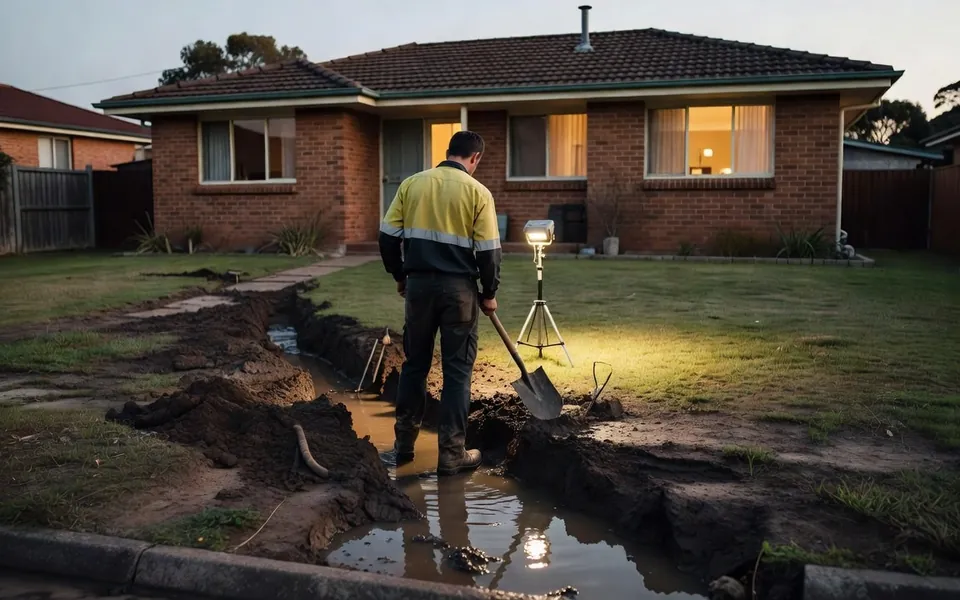
Burst pipes, blocked drains, gas leaks and hot water failures — handled by licensed Victorian plumbers across Geelong, the Bellarine and the Surf Coast. If water is running right now, turn it off at the meter first, then tell us what's happening.
No obligation. Takes 30 seconds.
One plumber takes your job from the first call to the finish. This is how we handle it.
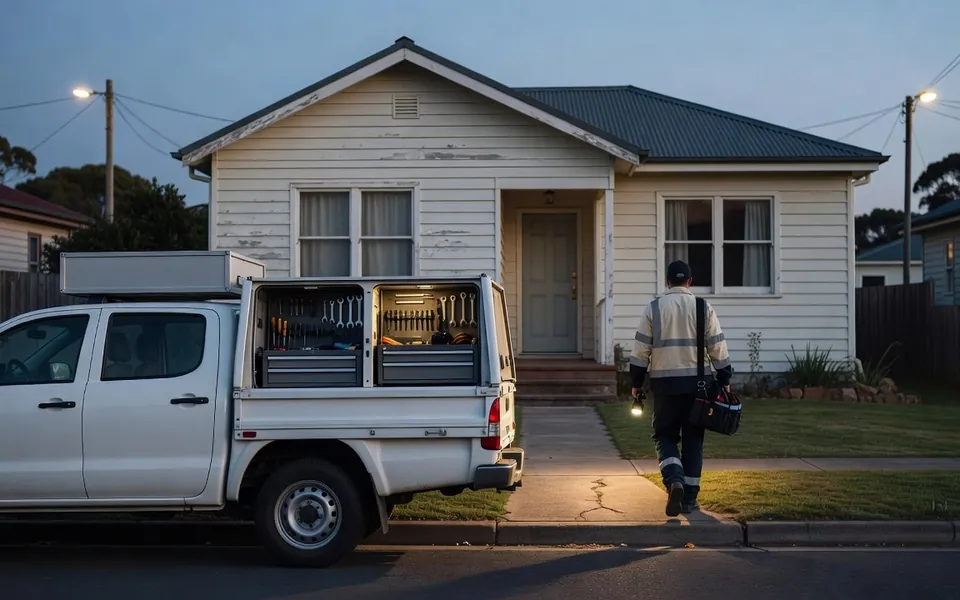
When we take the job, you get a name and a rough arrival time, and we ring if it changes. Not knowing whether anyone is on the way makes an emergency harder to manage.
We tell you what the attendance costs and what the job is likely to run before we start. If opening it up changes the number, we tell you then — not on the invoice.
Original earthenware sewers, galvanised supply lines and pre-war fittings fail differently from a 2020 estate build. Say which you have when you call, so we bring the right parts.
After-hours rates are higher: $180 – $400 for the call-out alone in our indicative ranges. We give you the figure on the phone, before we come out.
Tell us what's happening and one plumber takes it from the first call to the finish. If you'd rather pick, the main services are below.

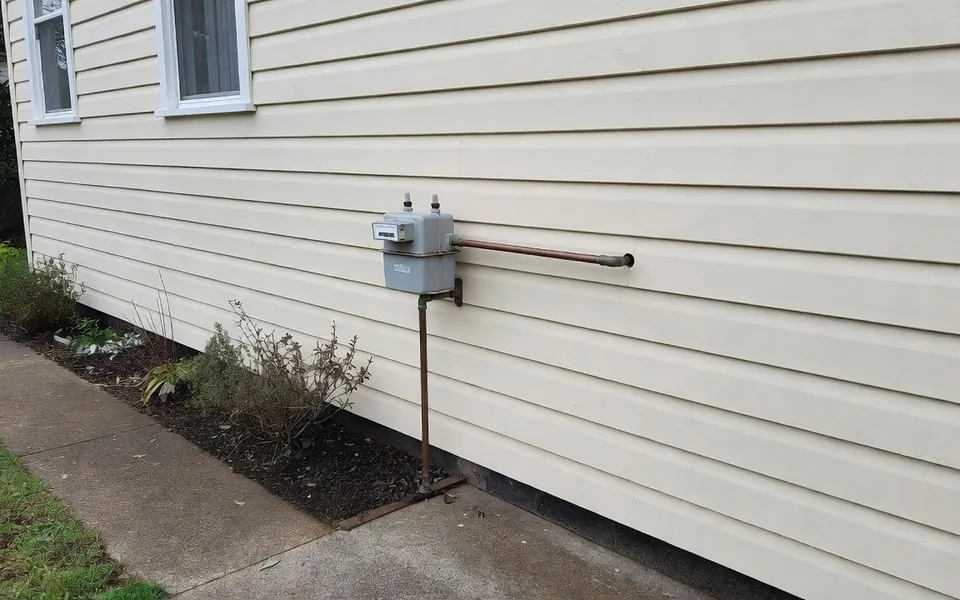
Need someone now? Water running, a gas smell, or sewage inside.
Read more →
Can't stop the water coming out of a pipe.
Read more →
Slow, gurgling or backing up — and why the same drain keeps doing it.
Read more →
No hot water, not enough, or a unit leaking — and repair versus replace.
Read more →
A gas smell is a life-safety situation, not a plumbing inconvenience.
Read more →
Rising, not flushing, or overflowing — and whether it's the pan or the sewer.
Read more →
A bill that's climbed, a damp patch, or a meter that ticks with everything off.
Read more →
Nights, weekends and public holidays — what it costs and when it's worth it.
Read more →If you have not had to do this before, this is the shape of it, start to finish.
If water is running, the meter tap at the front boundary closes it off — clockwise, usually under a small cover. Once it is off, the damage stops getting worse and the job gets cheaper. That single step matters more than how fast anyone drives.
What you can see, when it started, whether water is still running and where the meter is. A burst under a slab needs different gear from a job described as 'a leak', and knowing which saves a second trip.
If opening it up changes the picture, we give you the new price at that point, before we keep going — not on the invoice.
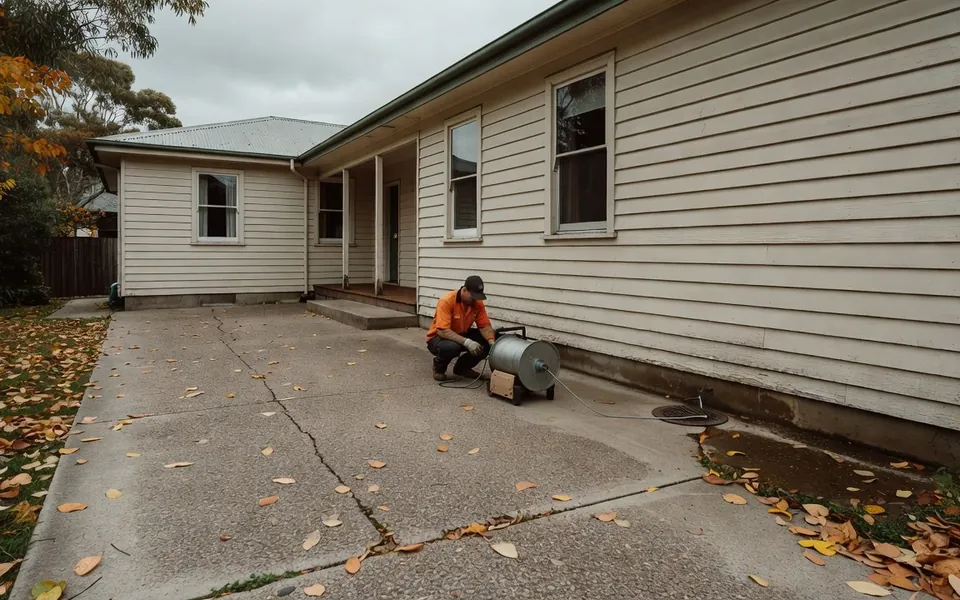
A drain cleared three times in a year has something physically wrong with it — roots at a joint, a collapsed section, lost fall. Clearing it again restores flow without changing anything. On our indicative ranges a camera inspection ($150 – $400) costs less than a machine clear ($200 – $550), so after the second blockage we put a camera down it.
Work of $750 or more needs a compliance certificate, which is your evidence the work was done properly and matters if you ever claim on it. The plumber must give it to you within five days.
Three local conditions shape plumbing faults in this region: cold winter nights, old clay sewers under established trees, and coastal houses that fill up and empty out with the holidays. Knowing which one applies to your house usually tells you how urgent it is.
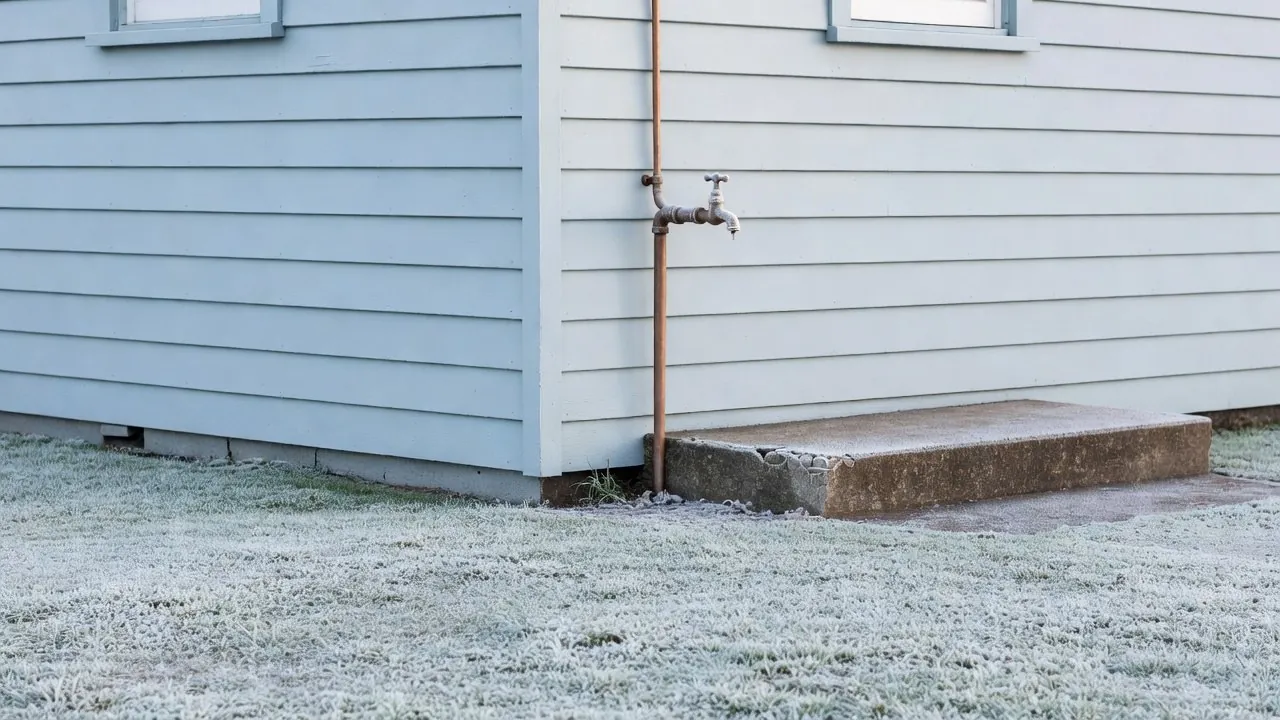
Geelong gets cold nights from June to August, but frost is rare: the Bureau of Meteorology's Breakwater station records fewer than one night a year at or below 0 °C. Water only bursts a pipe by freezing inside it, so the pipes at risk are the exposed ones on the colder outskirts — an unlagged run in a roof space, on an external wall or at a garden tap. The bigger winter factor is load: hot water systems work hardest in the coldest weeks, and a unit near the end of its life is under the most strain then. The measured figures are in the table below.
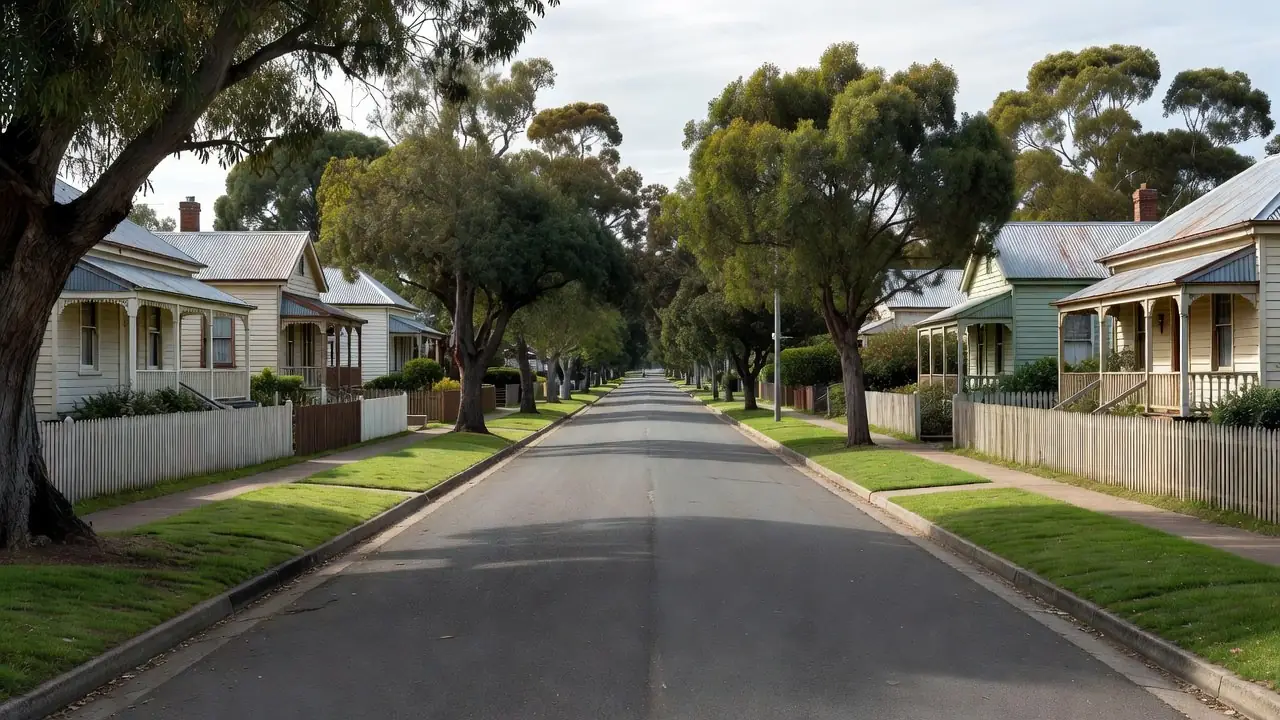
Pre-war houses in Geelong West, Newtown and East Geelong, and early post-war houses in Herne Hill, may still be on their original earthenware sewer lines with mortared joints. Established street trees can find those joints, because the joints are where the moisture is. It is also why the same house blocks repeatedly — clearing the roots does not repair the joint they came through.
Holiday houses in Torquay, Jan Juc, Ocean Grove, Barwon Heads and Queenscliff can go from empty to full over summer and at Easter. A drain or septic system that copes with two people may then carry a full house for a fortnight, and a partial blockage can show up then. Holiday houses also sit empty for months, which lets seals dry out and traps lose their water seal.

Two of these three are seasonal, which means they're partly preventable. Lagging exposed pipework before winter, clearing gutters in autumn, and turning a holiday house's water off at the meter when it stands empty all cost little.
The Bureau of Meteorology's averages for Geelong, read for the three things this page looks at: frozen pipes, hot water load and storm water.
| Month | Mean minimum | Nights at or below 0 °C | Mean rain | Wettest day on record |
|---|---|---|---|---|
| January | 14.8 °C | 0.0 | 39.4 mm | 44.8 mm |
| June | 6.6 °C | 0.1 | 54.7 mm | 38.0 mm |
| July | 6.4 °C | 0.5 | 39.6 mm | 26.2 mm |
| August | 6.6 °C | 0.1 | 41.2 mm | 26.8 mm |
| October | 9.3 °C | 0.0 | 56.3 mm | 69.2 mm |
| November | 11.1 °C | 0.0 | 55.8 mm | 89.8 mm |
| Whole year | 10.2 °C | 0.7 | 524.8 mm | 89.8 mm |
Source: Bureau of Meteorology, Breakwater (Geelong Racecourse), station 087184. Temperature records 2011–2026, mean rain from 13 years of records. Frost comparison from Avalon Airport, station 087113, 1995–2026. Read 14 October 2026. Every figure is the Bureau's, not our estimate.
Frozen pipes are uncommon here. A pipe splits from cold only when the water inside it freezes. At the Breakwater station the air reaches 0 °C or below on 0.7 nights a year on average, and the coldest reading in its record is −2.2 °C, in July. Avalon Airport, north-east of the city, averages 5.2 frost nights a year, so the outskirts get more. Our reading: a freeze split can happen on an exposed pipe, but if a pipe fails in a Geelong winter, we show you the cause before calling it a freeze. Corroded galvanised pipe and failed joints fail in every season.
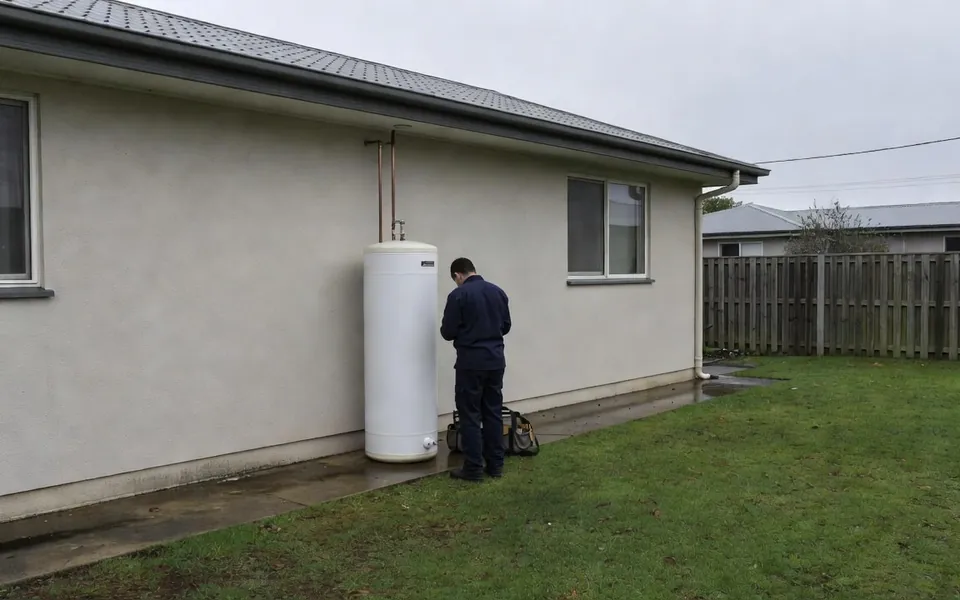
What winter does do is load the hot water unit. July is the coldest month at the station, with a mean minimum of 6.4 °C, and the mean maximum stays under 16 °C from June to August. A hot water unit runs hardest in those weeks. If the date on its plate says it is old, have it looked at in autumn rather than finding out in July.
The heaviest single days of rain fell in spring. In this record the two wettest days were in November (89.8 mm) and October (69.2 mm). A gutter, downpipe or stormwater pit that is still full of autumn leaves is tested hardest then, so clear them before spring, not only before winter.
Every job is two numbers added together: attendance, then the work. Attendance is $120 to $250 in business hours and $180 to $400 after hours, weekends and public holidays. A burst pipe, for example, comes to about $370 to $1,150 in business hours and $430 to $1,300 after hours, and access, not the part, usually decides where in that range you land. These are indicative ranges, not quotes; how they were compiled is on the cost page.
Emergency work splits into two parts: making it safe, which is fast, and fixing it properly, which sometimes is not.
| Make safe — isolate the leak or gas | Usually within the hour of arrival | Stopping the damage is always the first job, ahead of any repair. |
| Burst pipe repair | 1–3 hours | Longer if the pipe is under a slab or behind finished wall lining. |
| Blocked drain, machine clear | 1–2 hours | A CCTV inspection afterwards adds around 30–45 minutes. |
| Blocked toilet | 30–90 minutes | Usually straightforward unless the blockage is further down the line. |
| Hot water unit replacement | 2–4 hours | Same day if the unit is a common size and in stock. |
| Sewer or stormwater repair | Half a day to several days | Excavation, depth and reinstating the surface drive this, not the pipe work. |
When we price the job, we tell you whether it is likely to reach $750, because that is the point a compliance certificate becomes mandatory — and it should arrive within five days without you having to chase it.
Plumbing is a licensed trade in Victoria from end to end, which makes checking any plumber straightforward — there is a public register and it takes a minute. The part people miss is that registration and a licence are two different things.
Approval is required for:
Approval is not required for:
The BPC replaced the Victorian Building Authority on 1 July 2025 and maintains the public register of plumbing practitioners. You can look anyone up before they start. It is worth doing: work done by someone unregistered may not be covered by the mandatory plumbing insurance, and a licensed plumber issuing a certificate for work they didn't do or supervise is committing an offence that can leave you uninsured too. Source: Building and Plumbing Commission. Registered and licensed are two different statuses, and for work of $750 or more you need a licensed plumber. The BPC register settles it in a minute.
Full permit rules explainedCoverage runs across Geelong and the northern suburbs, out through Lara and Little River, across the Bellarine to Queenscliff and Portarlington, and down the Surf Coast to Torquay, Jan Juc and Anglesea.

Turn the water off at the meter — it's usually at the front boundary, and the tap turns clockwise. If you don't know where yours is, find it now rather than during an emergency. Once the water is off, open the lowest tap in the house to drain the pressure out of the system. Then ring us. Everything else waits.
Barwon Water, on 1300 656 007. That line is staffed 24 hours and covers bursts on the water main and sewer spills. Anything on your side of the meter is yours; anything on the street side is theirs, and you shouldn't be paying a private plumber for it.
Get everyone outside first. Don't touch light switches, don't use a phone inside, and put out any flame. Turn the gas off at the meter if you can reach it safely. Ring 000 if anyone is at risk, and ring AusNet Services — the gas distributor for western Victoria — on 13 67 07. Gasfitting is its own licence class and is never a do-it-yourself repair.
Yes. Plumbing work in Victoria can only be carried out by someone holding current registration or a licence, or an apprentice under supervision. There's a distinction that matters: a registered plumber must work under a licensed plumber, while a licensed plumber can work unsupervised and issue compliance certificates. The Building and Plumbing Commission keeps a public register you can check.
Any time the total value of the work — materials, appliances, labour and GST — is $750 or more. The plumber who did the work must give you a signed certificate within five days and lodge a copy with the BPC. It's evidence the work was done by a licensed practitioner and it matters for the mandatory plumbing insurance. Keep it with the house papers.
A line that blocks again in the same place has a physical fault. In the older suburbs — Geelong West, Newtown, Herne Hill, East Geelong — a likely cause is tree roots through the mortared joints of an earthenware sewer. Clearing the roots restores flow but doesn't repair the joint they came through, so they return. A camera inspection after the second blockage tells you whether you're facing a repair or an ongoing clean.
It's worth it for anything still releasing water, any gas smell, any sewage inside the house, and no hot water in genuinely cold weather with vulnerable people at home. A dripping tap, a slow drain or a single blocked toilet in a house with a second one can generally wait for business rates. Say which you have when you call.
Yes. We take jobs in Ocean Grove, Barwon Heads, Drysdale, Portarlington, Queenscliff and Point Lonsdale on the Bellarine, and in Torquay, Jan Juc and Anglesea on the Surf Coast, as well as in Geelong itself. Ocean Grove, Barwon Heads, Drysdale and Portarlington are in the City of Greater Geelong; Queenscliff and Point Lonsdale are in the Borough of Queenscliffe; Torquay, Jan Juc and Anglesea are in the Surf Coast Shire. Victorian licensing rules are set at state level, so they are the same on both sides of every council boundary.